Some time ago, I wrote an article about creating perfect APA page headers. Like anything having to do with computers, there is more than one way to do anything. The following is an alternate way of creating those perfect APA page headers.
NOTE: Clicking the images will enlarge them in a new tab/window.
STEP 1: Insert a blank header: Insert (tab) > Header drop-box (Header & Footer panel) > select Blank. You can also double-click in the header area to access the editable header.
STEP 2: The header should be left aligned by default. Simply enter the desired header text as you would expect it to appear on page 2 and subsequent pages. Next, press the keyboard’s Tab key until the cursor is aligned with the right margin.
NOTE: When inserting the page number: select Page Number drop-box (from either the Insert or Design tabs) > Current Position > Plain Number.
STEP 3: Select the Different First Page check-box in the Options panel under the Design tab. Do not worry if the header disappears.
STEP 4: Repeat steps 1 and 2, and insert the desired text (i.e., "Running head: . . . ") and page number where appropriate.
STEP 5: You can insert a page break in the main body of the manuscript to see if it works. Once beyond page 1, the running head (sans the phrase: "Running head:") should appear.
STEP 6: If it has not been done, double-click or highlight the header elements and format the text accordingly (i.e., 12-point, Times New Roman font).
This technique should work whether you use Word 2007, 2010, or 2013. If this technique does not work, try the aforementioned one.
This blog is a record of some of my work activities for Medicine Hat College Library Services.
Showing posts with label apa. Show all posts
Friday, April 12, 2013
Friday, February 17, 2012
Citing a Telephone Book (APA Style, 6th ed.)
![]() |
| Figure 1. Yellow Pages: Lethbridge and Area (ca. 2011) cover . (Click image to enlarge.) |
Like the previous APA edition, there is no one perfect answer to citing a telephone book. What I suggest may be interpreted differently by others. To this end this is my rationale for a general telephone book citation is as follows:
AUTHOR: -leave blank-
- Since the author is not explicitly given, lead with the title instead. The directory (as a whole) is written by many individuals, companies, and organizations—as demonstrated by some of the subsections and advertisements. It may not be best to attribute authorship solely to The Yellow Pages Group—though editorial credit could arguably be given to that group.
TITLE: Yellow pages: Lethbridge and area [Telephone directory].
- Since this “book” is not a book that has been published in the traditional sense (i.e., providing copyright date, proper title and publisher’s pages), provide the title of the publication (as disjointed as it seems) and display the “medium” in brackets. This description of the medium is not officially noted in the APA Manual, but it should clear up any confusion that may plague your audience. Review section 6.29 (pp. 185–186) of the APA Manual for details. The title is italicized, but the descriptor in brackets is not.
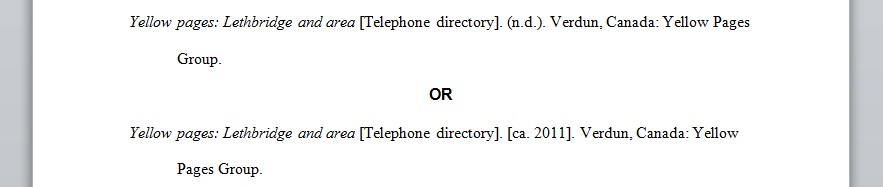
PUBLICATION DATE: n.d.
- Though we can reasonably assume that it was released in 2011, no explicit copyright date is given, so the use of “n.d.” for “no date" would be appropriate.
- Alternately, it may be permissible to use “[ca. 2011]” to indicate a reasonable estimate for the date of publication. An example of such a case can be found on pages 213–214 of the APA Manual.
PLACE OF PUBLICATION: Verdun, Canada.
- The Yellow Pages Group has many offices across Canada, however, their website (http://www.ypg.com/en/about-us/company-profile) tells us that the head office is in Verdun, Québec, Canada. It may be fair to use this as the place of publication.
- NOTE: In the 6th edition, you only need to include the city and country for publisher location if it is outside the U.S.A., so: Verdun, Québec, Canada or Verdun, QC would not generally be acceptable.
PUBLISHER: Yellow Pages Group.
- This much still seems (somewhat) clear.
If you use a particular subsection of the book or advertisements, etc., then everything we have written thus far, may be thrown out the window. A future post will advise you on citing a particular advertisement.
If you want a second opinion, you can prompt an APA expert at The APA Style Blog. They will take suggestions and write about popular queries.
Wednesday, November 18, 2009
APA 6th Ed. Beefs
Recently I said that some some people were feeling "burned" by the latest (6th ed.) release of the Publication Manual of the American Psychological Association. I was then asked what people were feeling "burned" about. To this end, I provided the following list:
- The two spaces after a period rule returning definitely ignited the passions of many (http://blog.apastyle.org/apastyle/2009/07/on-two-spaces-following-a-period.html).
- A library director that I have been corresponding with finds much consternation in the heavy emphasis of digital object identifiers (DOIs) for journal citations.
- The sample papers that the APA produced in the 1st printing were often contradictory to the manual’s textual explanations, which were Spartan to begin with.
- Many were upset that the manual was so filled with errors that they would either have to fill their existing copies with red ink to fix the corrections or they would have to carry around several pages of PDF printouts with the corrections and revised sample papers.
- The APA’s nonchalant attitude—constantly emphasizing their “flexibility.” Flexibility is fine, until it encounters an instructor’s rubric. [I am still trying to get a straight answer about margin and header placement—I did get a reply from APA, but the “Style Expert” told me two contradictory things in as many sentences.]
- The information expressed in the publication manual, concise rules book, and workbooks can contradict each other—even though they are all APA publications.
- The lack of good citation examples. The APA released a brilliant companion manual (APA Style Guide to Electronic Citations) in 2007, but many of the examples were not carried over into the new book—which is 100 pages shorter than the 5th ed.
- Some take exception to the poor indexing of the manual.
- My personal beef is the lack of proper scaling in the sample papers—a sentiment that I am not alone in expressing. The APA says that it was not possible, however, this was done in the previous version.
- Boycott the APA Manual (Facebook Group)
- APA Style Blog (official blog)
- APA Publication Manual (an independent blog)
Wednesday, October 3, 2007
AAQ - Citing a Telephone Book (APA Style, 5th ed.)
UPDATE (17 February 2012): An update of this entry has been post. Click here for the revised 6th edition version.
ORIGINAL ENTRY:
This is the latest AAQ that I answered. Unfortunately it is one of those questions that has no absolute answer - as you might read.
Hello and thank you for using the “Ask A Question” service.
You are inquiring about how to cite a local telephone book.
Given the nature of your program, I am assuming that you will be using the American Psychological Association (APA) system of citation. Unfortunately, the 5th edition of the Publication Manual of the American Psychological Association (APA Manual) does not specify a means of citing a phone book.
To this end, we can suggest that you use the following information:
AUTHOR: -leave blank-
– Since the author is not explicitly given, use the title instead. The directory (as a whole) is written by many individuals, companies, and organizations – as demonstrated by some of the subsections and advertisements. We do not believe that the Yellow Pages Group can be attributed as the author – though editorial credit could arguably be given to that group.
TITLE: Yellow pages: 2007/2008 Medicine Hat and area [Telephone directory].
– Since this “book” is not a book that has been published in the traditional sense (i.e., providing copyright date, proper title and publisher’s pages), provide the title of the publication (as disjointed as it seems) and display the “medium” in brackets. This description of the medium is not officially noted in the APA Manual, but it should clear up any confusion that might plague your audience – review section 4.12 (p. 228) of the APA Manual for details. The title is italicized, but the descriptor is not.
PUBLICATION DATE: n.d.
– Though we can reasonably assume that it was released in 2007, no explicit copyright date is given, so use “n.d.” for “no date”.
PLACE OF PUBLICATION: Burnaby, British Columbia, Canada.
– The Yellow Pages Group has many offices across Canada, but the Burnaby address is given near the front of the book.
PUBLISHER: Yellow Pages Group.
– This much seems (somewhat) clear.
So your basic reference might be ordered as:
Yellow pages: 2007/2008 Medicine Hat and area [Telephone directory]. (n.d.). Burnaby, British Columbia, Canada: Yellow Pages Group.
– Be mindful of properly employing the hanging indent, double-spacing, and italicization of title.
NOTE: If you use a particular subsection of the book or advisements, etc., then everything we have written thus far, might be thrown out the window. We suggest that you visit the Information Desk of the Vera Bracken Library for further assistance.
Thank you again for using the “Ask A Question” service. If you need more help, please use the service again or see the Information Desk in the Medicine Hat College Library (phone #: (403) 529-3867).
AAQ#: 37241
Subscribe to:
Posts (Atom)